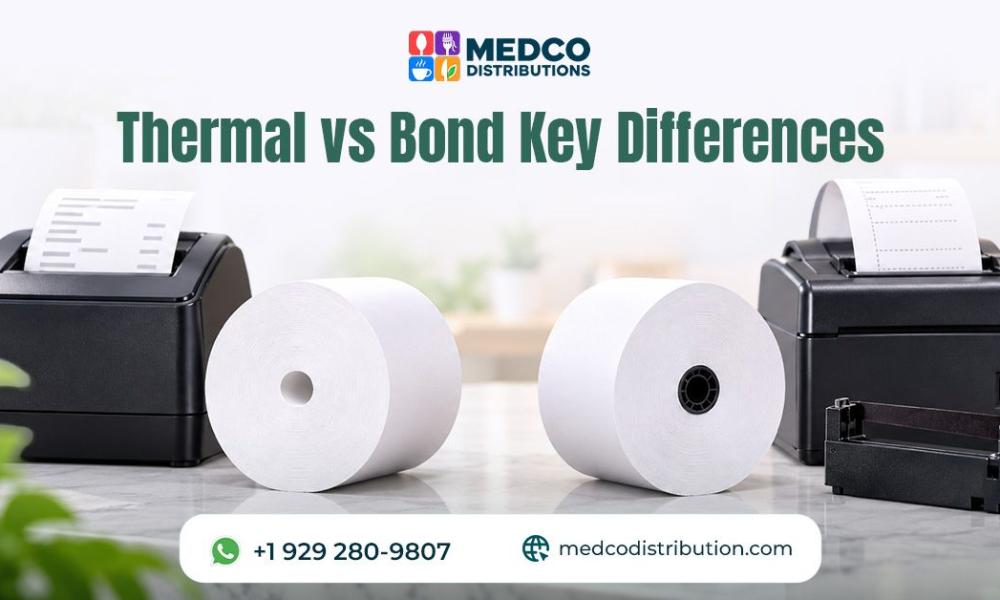
Thermal Paper vs. Bond Paper Receipt Rolls: What’s the Difference?
It is a Friday night at a busy neighborhood restaurant. The dining room is full, the phone keeps ringing, and the owner has just loaded a fresh roll into the kitchen printer. Orders go in. Nothing comes out.
Or worse, the tickets print so faint that the line cook is guessing at a side dish. Ten minutes later, someone spots the problem. The roll was thermal paper. The kitchen printer was an impact model that needed bond paper and a ribbon.
This mix-up happens more often than you would think. Both products are sold as receipt paper rolls. They look alike on a shelf and they come in the same widths. But they work in completely different ways, and the wrong one simply will not print right.
This guide explains thermal paper vs bond paper receipt rolls in plain language. You will learn how each one prints, how to tell which one your machine needs, what each costs to run, and where each one works best. By the end, ordering register rolls should feel easy.
The Short Answer
Thermal paper has a heat-sensitive coating. The printer warms the paper, and the image appears. There is no ink and no ribbon.
Bond paper is plain, uncoated paper. An impact printer strikes an inked ribbon against it, much like a typewriter. The paper itself does not react to heat at all.
Your printer decides which roll you need. Thermal printers use thermal paper. Impact printers use bond paper and a ribbon. That one rule solves most ordering problems.
What Is Thermal Paper?
Thermal paper starts as an ordinary base sheet. One side carries a special coating that holds a colorless dye and a developer. When heat touches the coating, the two react and turn dark. That is the whole trick.
A thermal receipt printer has a row of tiny heating elements in its print head. As the paper slides past, the elements warm up in exactly the right spots. Letters, numbers, logos and barcodes appear. You can read more about the technology in this overview of thermal printing.
Because nothing is sprayed or struck, the printer has very few moving parts. There are no cartridges to refill and no ribbons to change. That is why most modern point of sale systems use thermal receipt paper for customer receipts.
What thermal paper does well
- Prints fast, which keeps checkout lines moving
- Runs quietly, so the front counter stays calm
- Gives sharp text, logos and barcodes
- Needs no ribbon or ink, so there is less upkeep
- Works in small, compact printers and handheld card terminals
Where thermal paper struggles
- Heat, bright light and friction can darken or fade the print
- It is a poor fit for hot, greasy or steamy spots
- It makes one copy at a time, with no carbon copies
- The coating usually makes it unsuitable for the recycling bin
A receipt kept in a cool, dark drawer can stay readable for a long time. One left on a sunny car dashboard can go dark or blank fast. That sensitivity is the price of printing without ink.
What Is Bond Paper?
Bond paper is regular, uncoated paper in roll form. It has no chemical layer and no heat reaction. If you held it next to a thermal roll, it would look a little duller and feel less slick.
It works with impact printers, also called dot matrix printers. Inside, a print head fires tiny pins that strike an inked ribbon against the paper. Each strike leaves a dot, and the dots form letters. If you are curious about the mechanics, here is a short explanation of impact printers.
You will find impact printers mostly in restaurant kitchens and bars. Popular kitchen models, such as the Epson TM-U220 and the Star SP700, commonly run on 3 inch bond rolls. Always confirm the exact size in your printer manual before you order.
What bond paper does well
- Handles heat, steam, grease and humidity without going dark
- Keeps its print, since the ink sits on the paper and does not depend on a coating
- Supports multi-ply rolls, which give you two or three copies at once
- Prints with a loud chatter that helps cooks notice a new ticket
Where bond paper struggles
- It needs a ribbon, which wears out and must be replaced
- Printing is slower and louder than thermal
- Dot matrix text looks rougher, and logos or barcodes are limited
- Impact printers are bulkier and need more maintenance
A faded ribbon is the number one reason kitchen tickets turn light and hard to read. If your tickets look weak, check the ribbon before you blame the paper.
Thermal Paper vs. Bond Paper: Side by Side
|
Feature |
Thermal paper rolls |
Bond paper rolls |
|---|---|---|
|
How it prints |
Heat reacts with the coating |
Pins strike an ink ribbon |
|
Ribbon needed |
No |
Yes |
|
Printer type |
Thermal receipt printer |
Impact (dot matrix) printer |
|
Print quality |
Sharp, supports logos and barcodes |
Basic dot matrix text |
|
Speed and noise |
Fast and quiet |
Slower and louder |
|
Heat and grease |
Sensitive, can darken |
Handles it well |
|
Multiple copies |
No |
Yes, with 2-ply or 3-ply rolls |
|
Common use |
Front counter and POS receipts |
Kitchen and bar tickets |
Neither one is better in every case. The right choice depends on the printer you own and the place it sits.
How to Tell Which One Your Printer Needs
You do not need to guess. Try these quick checks.
- Open the lid. If you see an ink ribbon cartridge, you have an impact printer and you need bond paper. If there is no ribbon, it is a thermal printer.
- Look up the model number. The manual or the manufacturer’s site will name the paper type, the width and the maximum roll diameter.
- Listen to it. A buzzing, chattering sound means impact printing. A soft whir means thermal.
- Try the fingernail test. Drag a fingernail across the paper surface. Thermal paper leaves a dark line because of friction heat. Bond paper does not.
- Feel the surface. Thermal paper often feels smooth and slightly glossy on the coated side.
If the checks disagree, trust the manual. It is the final word on what your printer can use.
What Happens If You Use the Wrong Paper?
Put bond paper in a thermal printer and the receipt comes out blank. The paper has no coating, so there is nothing for the heat to react with.
Put thermal paper in an impact printer and you are working against the design. These machines are built for plain paper and a ribbon, and printer makers recommend bond rolls for them. Results are poor at best.
Either way you waste paper, time and patience. A quick check before each order is cheap insurance.
Which Roll Is Right for Your Business?
The best answer changes with the business. Here is how it usually plays out.
Restaurants and cafes. Many use both. Thermal rolls print customer receipts at the front counter, while bond rolls feed the impact printer in the kitchen. If you run a take-out heavy menu, you may also be stocking hinged take-out containers and other packaging, so it helps to order your paper and packaging together.
Retail stores and boutiques. Thermal is the standard. It prints quickly, stays quiet and gives a clean, professional receipt with your logo or return policy.
Grocery stores and convenience stores. Busy lanes need speed. Thermal rolls keep customers moving and do not require ribbon changes during a rush.
Food trucks and pop-up stalls. Compact thermal printers and handheld terminals fit small spaces. Smaller rolls suit them well.
Hot, greasy or humid work areas. A kitchen line, a fryer station or a steamy prep area can ruin thermal print. Bond paper is the safer pick there.
Offices and service desks that need duplicates. Multi-ply bond rolls give you a customer copy and a store copy in one pass. For handwritten orders, you can also look at guest check pads.
Cost: What You Really Pay
The price on the roll is only part of the story.
With thermal, the paper is almost the only recurring cost. There is no ribbon to buy and no ribbon to replace. Over a year, that simplicity adds up, especially for a busy register.
With bond paper, you buy the paper and the ribbon. Ribbons wear down with use, and a tired ribbon gives faint tickets. Factor in both when you compare totals.
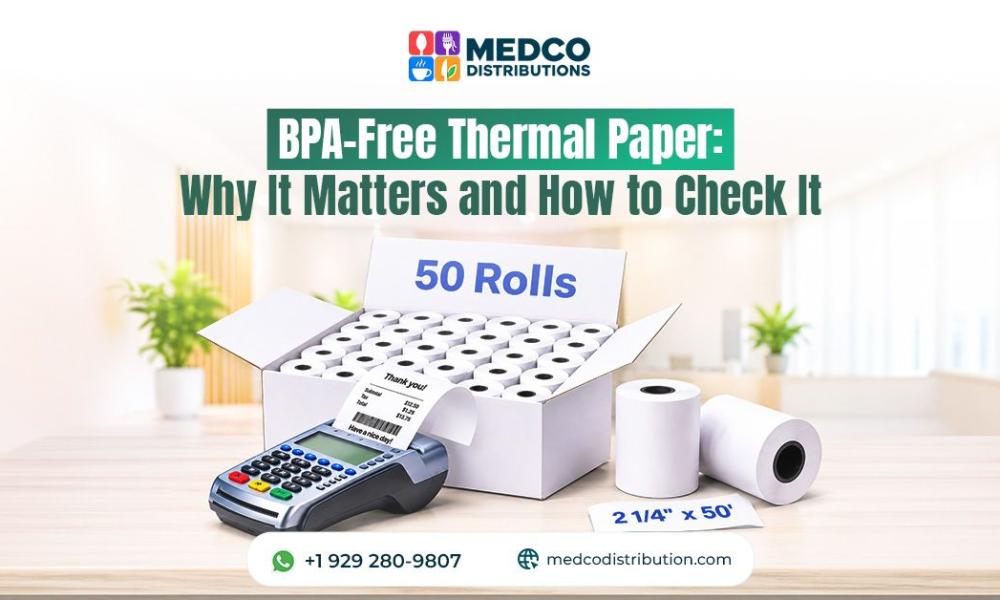
To give you a real number, here is what thermal rolls cost at Medco Distributions at the time of writing. A case of 50 rolls in the 2 1/4″ × 60′ size is $23.99, which works out to under 50 cents a roll. A case of 50 rolls in the 3 1/8″ × 230′ size is $54.99, or about $1.10 a roll. The longer roll also means fewer changes during a shift.
Orders over $200 ship free, and orders over $1,800 get 10% off automatically. A full case or two of register rolls can get you most of the way to free shipping.
Durability and Storage
Thermal prints are not meant to live forever. Heat, sunlight, humidity and rubbing can all weaken the image. A few simple habits help.
- Store unused rolls in a cool, dry place, away from windows and heaters.
- Keep the roll in its wrapper until you are ready to use it.
- Do not stack heavy items on printed receipts or store them near plastic folders or adhesives.
- If you must keep a transaction record for years, scan or photocopy the receipt.
Bond prints hold up better because the ink does not rely on a coating. They are a safer choice for tickets that may sit near a hot grill or a warm window. For tax and record-keeping rules, check with your accountant, since requirements vary by business.
Health and Environmental Questions
You may have heard that thermal receipts contain bisphenols. It is a fair question, so here is a balanced look.
Many thermal papers use a bisphenol, usually BPA or BPS, as the developer in the coating. A study published through the National Library of Medicine, available on PubMed, found that the receipts it tested contained 1 to 2 percent of these compounds by weight. It also found higher levels of one alternative compound in the urine of cashiers who handled receipts made with it. The researchers concluded that thermal receipt paper can be an occupational source of exposure.
Putting that in context, a consumer advocacy piece from the Center for Science in the Public Interest notes that for most people, handling a receipt is probably a very low-risk activity. Cashiers and other workers who handle hundreds a day are the group that tends to think harder about it.
If you want to reduce exposure at your business:
- Offer email or text receipts when customers are happy with them.
- Let staff wash their hands after handling stacks of receipts.
- Ask your supplier about the coating on the roll you plan to buy.
There is a recycling point too. The Environmental Working Group advises in its article on bisphenol receipts that thermal paper should go in the trash, not the recycling bin, because it can contaminate the recycled paper stream. It also notes that the European Union banned BPA in thermal paper at the start of 2020.
Bond paper has no thermal coating, so these particular concerns do not apply to it.
Common Mistakes to Avoid
- Ordering by looks. Two rolls can look the same and need different printers. Always match the paper to the printer type.
- Ignoring the width. A roll that is a little too wide or too narrow will not feed or print correctly.
- Skipping the diameter. Your printer has a maximum roll diameter. A roll that is too thick will not fit the paper bay.
- Forgetting the ribbon. With impact printers, faint tickets usually mean a worn ribbon, not bad paper.
- Storing rolls in hot places. A shelf above the stove or beside a sunny window can darken thermal paper before you use it.
- Recycling thermal receipts. Put them in the trash instead.
How to Choose the Right Roll Size
Roll size is described by width, length, outer diameter and core size. Your printer manual lists the right numbers.
Width is the big one. Standard full-size point of sale printers commonly take 3 1/8″ wide rolls. Handheld card terminals and compact printers often use 2 1/4″ rolls. Length matters too. A longer roll lasts longer between changes, as long as it still fits the paper bay.
When in doubt, measure the old roll and compare it to the manual. If you are still unsure, contact our team and we will help you match the roll to your machine.
Thermal Paper Rolls at Medco Distributions
Medco Distributions stocks thermal cash register and POS paper rolls in two popular sizes. Each size comes in three brands, so you can choose the one that suits your budget and your brand preference. You can browse the full range in our thermal paper rolls category, or explore the wider receipt paper rolls and POS paper section.
|
Size |
Case |
Price |
Brands |
|---|---|---|---|
|
2 1/4″ × 60′ |
50 rolls |
$23.99 |
|
|
3 1/8″ × 230′ |
50 rolls |
$54.99 |
If you run an impact kitchen printer and need bond rolls, reach out through our contact page to ask about availability. You can also read our FAQ for ordering and shipping details, and visit our blog for more guides on restaurant and retail supplies.
Frequently Asked Questions
Can I use thermal paper in an impact printer?
It is not recommended. Impact printers are designed for plain bond paper and an ink ribbon. Use the paper type your printer maker specifies.
Can I use bond paper in a thermal printer?
No. Bond paper has no heat-sensitive coating, so a thermal printer will output a blank receipt.
How can I tell if a roll is thermal paper?
Scratch the surface with a fingernail. If a dark line appears, it is thermal paper. The coated side is also usually smoother and slightly glossy.
Do thermal receipts fade?
Yes, over time and faster with heat, light and friction. Store receipts in a cool, dark place, and scan any you need to keep for the long term.
Is thermal paper recyclable?
Usually not. The coating can contaminate recycling, so most guidance says to place it in the trash.
What size receipt roll do I need?
Check your printer manual for width and maximum roll diameter. Full-size POS printers commonly use 3 1/8″ rolls, while handheld terminals often use 2 1/4″ rolls.
Does Medco Distributions offer free shipping?
Yes. Orders over $200 ship free, and orders over $1,800 receive 10% off automatically.
Final Thoughts
The difference between thermal paper and bond paper receipt rolls comes down to one question: how does your printer make its mark? If it uses heat, you need thermal. If it uses a ribbon, you need bond.
Get that match right, check the width and diameter, and store your rolls somewhere cool. Do that, and you will avoid blank receipts, faint tickets and rushed reorders.
Ready to restock? Browse our thermal paper rolls and pick the size that fits your register. If you need a hand matching a roll to your printer, our team is happy to help.