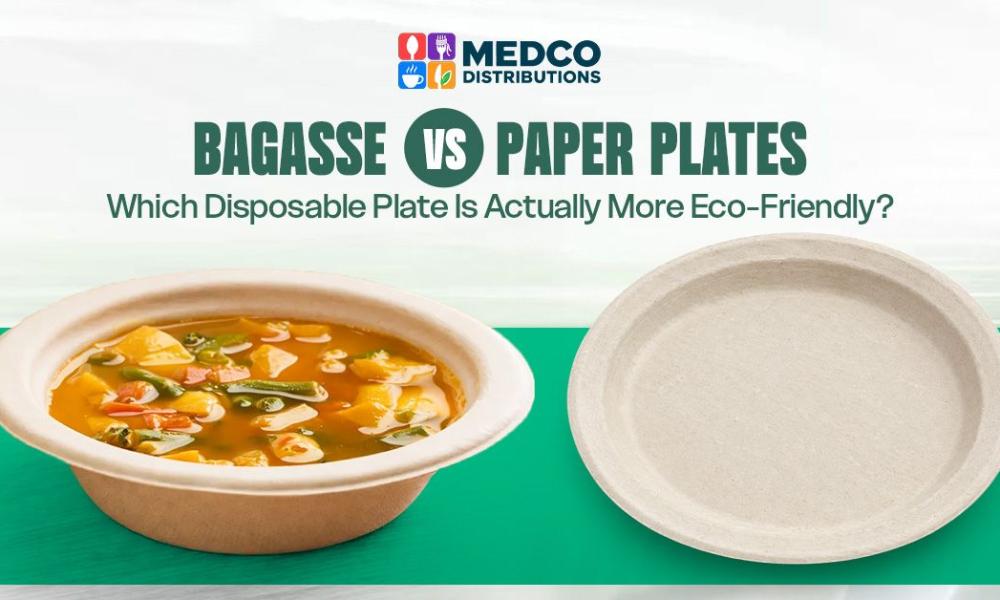
Bagasse vs. Paper Plates: Which Disposable Plate Is Actually More Eco-Friendly?
Walk into any restaurant supply store and ask for "eco-friendly plates" and you'll probably get handed two very different products. One looks like a classic paper plate, maybe a little thicker than the kind from a backyard barbecue. The other is a slightly tan, slightly textured plate that feels almost like pressed cardboard. That second one is bagasse, and a lot of buyers assume it's just a fancier, pricier version of paper.
It isn't. The two materials come from completely different sources, break down in completely different ways, and honestly hold up very differently once hot or greasy food hits them. If you're choosing between the two for your restaurant, deli, or catering business, it's worth understanding what you're actually buying before you commit to a case order.
What Paper Plates Are Actually Made Of
Standard paper plates start as wood pulp, the same basic raw material behind most paper products. Trees get harvested, chipped, and processed into pulp, which is then pressed, dried, and shaped into plates.
Plain, uncoated paper plates are relatively simple products. The problem is that plain paper doesn't hold up well against moisture or grease, so most commercial paper plates get a thin coating, often a plastic film or wax layer, to keep them from going soft the moment food touches them.
That coating matters more than most people realize. A plain paper plate is genuinely biodegradable and often recyclable. Once you add a plastic coating, both of those things become a lot less true, since the coating has to be separated from the paper fiber before either recycling or composting can happen properly, and most facilities aren't equipped to do that.
What Bagasse Actually Is
Bagasse is the fibrous material left over after sugarcane stalks have been crushed to extract their juice. Sugar mills produce enormous volumes of it as a byproduct of making sugar, and for a long time, a lot of it just got burned or discarded. Turning it into molded tableware gives that leftover material a second use instead of letting it go to waste.
This is the detail that makes the sourcing comparison lopsided in bagasse's favor. Paper plates require a tree to be grown and harvested specifically to become paper. Bagasse plates use material that was already being produced as a byproduct of growing sugarcane for an entirely different purpose. No additional land, water, or growing time gets dedicated purely to make the plate.
Comparing the Two Materials Side by Side
|
Factor |
Bagasse Plates |
Paper Plates |
|
Raw material |
Sugarcane fiber (byproduct of sugar production) |
Wood pulp (trees harvested for paper) |
|
Dedicated resource use |
Uses existing agricultural byproduct |
Requires dedicated timber and pulping resources |
|
Water intensity of production |
Lower, no separate pulping of virgin fiber required |
Pulp and paper manufacturing is water intensive |
|
Grease and moisture resistance |
Naturally sturdy without needing a plastic coating |
Usually needs a plastic or wax coating to resist moisture |
|
Compostability |
Generally compostable, often certified |
Only uncoated paper composts easily; coated paper usually doesn't |
|
Heat tolerance |
Holds up well with hot, oily food |
Can soften or sag with hot or greasy food |
The Water and Energy Reality Behind Paper Production
It's easy to assume paper is automatically the "natural" choice since it comes from trees rather than agricultural waste. But the manufacturing process tells a more complicated story.
According to the EPA's own sector analysis of the pulp and paper industry, pulp and paper manufacturing is the largest industrial consumer of process water in the United States, and a bleached kraft pulp mill can require somewhere between 4,000 and 12,000 gallons of water for every ton of pulp produced. The same EPA documentation notes the industry ranks among the largest industrial energy consumers as well.
None of that is a knock on the paper industry specifically. Modern mills have made real progress reducing water and energy use compared to decades ago. But it does mean that framing paper as the automatically "natural" or lower-impact option isn't quite accurate once you look at what actually goes into producing it. Bagasse, by comparison, starts from a fiber source that's already been grown and processed for sugar, so the plate itself isn't the reason that water and land got used in the first place.
Which One Actually Composts?
This is where the gap between the two materials becomes most obvious in daily use.
Plain, uncoated paper plates can compost relatively easily, since they're just pressed wood fiber. But most commercial paper plates aren't plain. They're coated to resist grease and liquid, and that coating is typically what prevents the plate from composting properly or being accepted at a recycling facility. A coated paper plate sitting in a backyard compost pile can take years longer to break down than people expect, if it breaks down at all in any meaningful way.
Bagasse plates are usually certified compostable without needing that same kind of synthetic coating, because the fiber itself is naturally more resistant to moisture and grease. Certification typically follows ASTM D6400, the same industry standard covered by BPI (Biodegradable Products Institute) certification, which verifies a product actually breaks down into usable compost within a defined, tested timeframe rather than just eventually degrading someday.
One caveat worth repeating from compostable packaging generally: most bagasse products are certified for commercial composting facilities, not backyard compost piles. If your business or your customers don't have access to municipal or commercial composting pickup, a bagasse plate thrown in regular trash won't necessarily break down any faster than a conventional one, since landfills don't provide the oxygen and heat that composting actually requires.
The PFAS Question Nobody Mentions Enough
Here's a detail that's become increasingly relevant for anyone buying paper or molded fiber food packaging in New York specifically, and it applies to both paper and bagasse products.
For years, many paper and molded-fiber food containers relied on PFAS (per- and polyfluoroalkyl substances) as a grease-resistant coating, the same family of "forever chemicals" that's drawn serious regulatory attention nationwide. New York banned intentionally added PFAS in food packaging effective December 31, 2022, and according to the New York State Department of Environmental Conservation, the law specifically covers packaging "comprised, in substantial part, of paper, paperboard, or other materials originally derived from plant fibers," which includes both coated paper products and molded fiber items like bagasse.
This means grease resistance in either material now has to come from somewhere other than PFAS coatings if the product is sold in New York. When you're sourcing either paper or bagasse plates, it's worth specifically confirming "no PFAS added" with your supplier rather than assuming compostable automatically means PFAS-free, since the two issues aren't the same thing.
Strength and Performance: Where Bagasse Usually Wins
Environmental sourcing aside, there's a very practical reason a lot of restaurants switch to bagasse specifically: it just performs better under real kitchen conditions.
Standard paper plates, even decent quality ones, tend to flex and sag once they're holding something hot, wet, or oily for more than a few minutes. Anyone who's balanced a paper plate of saucy barbecue at a backyard cookout knows exactly what that failure point feels like.
Bagasse has a denser, more rigid structure straight out of the mold. It holds up noticeably better against grease, sauce, and heat without needing a plastic liner to do the work. For foodservice operations plating hot entrees, that difference in reliability often matters more day to day than the sourcing story.
Cost: The One Place Paper Still Has an Edge
It's worth being honest about this instead of pretending bagasse wins every category. Plain paper plates are generally cheaper to produce and buy in bulk than bagasse, largely because paper manufacturing infrastructure is older, more widespread, and more efficient at scale.
If your operation is using plates for something low-stakes, dry snacks, light appetizers, situations where moisture and grease resistance don't matter much, a basic uncoated paper plate might genuinely be the more sensible and more sustainable choice, since you're not paying for strength you don't need.
So Which One Is Actually More Eco-Friendly?
Taking sourcing, water and energy intensity, compostability, and real-world durability together, bagasse comes out ahead for most restaurant and catering use cases, particularly anywhere hot or greasy food is involved. It uses a byproduct material rather than dedicated virgin resources, generally composts without needing a plastic liner, and holds up better under the conditions most foodservice businesses actually deal with.
Paper still has a place, especially for lighter-duty, lower-moisture applications where cost matters more than performance, and especially when it's genuinely uncoated rather than plastic-lined.
The honest answer, though, is that the "eco-friendly" label depends heavily on what happens after the plate leaves your counter. A compostable bagasse plate that ends up in a landfill with no composting access doesn't deliver much of an environmental advantage over a coated paper one. Before leaning hard into either material as your sustainability pitch to customers, it's worth checking what composting or recycling infrastructure actually exists in your market.
Frequently Asked Questions
Are bagasse plates more expensive than paper plates?
Generally yes, bagasse plates tend to cost more per unit than basic coated paper plates, though the gap has narrowed as bagasse production has scaled up. Many operators find the improved durability offsets some of that cost difference by reducing double-plating or spills.
Can bagasse plates go in the microwave?
Most bagasse products are microwave safe, which is a real advantage over many coated paper plates. Always check the specific product's labeling, since formulations vary by manufacturer.
Is bagasse the same thing as sugarcane plates?
Yes, "bagasse" and "sugarcane fiber" refer to the same material. Bagasse is the technical term for the fibrous residue left after sugarcane is processed for its juice.
Do bagasse plates smell or taste like sugar?
No. The fiber goes through processing that removes sugar content before it's molded into tableware, so there's no sweet taste or smell transferred to food.
Are all paper plates recyclable?
Only uncoated ones, realistically. Plastic or wax coated paper plates usually aren't accepted by standard paper recycling programs, since the coating has to be separated from the fiber first, which most facilities aren't set up to do.
Choosing the Right Plate for Your Business
If your menu involves anything hot, saucy, or greasy, bagasse is generally the more reliable and more genuinely sustainable choice, assuming your market has access to composting infrastructure to make that sustainability claim actually mean something. For lighter, drier applications, a quality uncoated paper plate can still be a perfectly reasonable option.
Medco carries both options in the paper plate, bowl, and PP plastic plate category, including bagasse plates in multiple sizes. If you're not sure which fits your menu and your local disposal options, reach out through our FAQ page and we can help you figure out the right call.