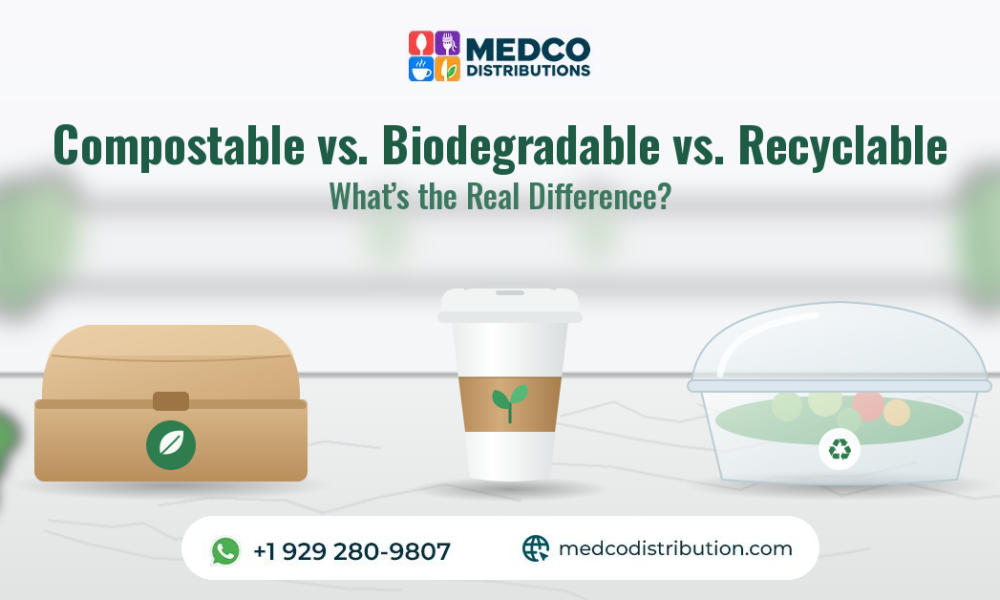
Compostable vs. Biodegradable vs. Recyclable: What's the Real Difference?
A restaurant owner messaged us a while back asking a question that seemed simple on the surface: "If I switch to compostable containers, can my customers just toss them in with their regular recycling?"
The honest answer was no. And that one question opened up a much bigger conversation, because it turns out most people, including plenty of smart business owners, use "compostable," "biodegradable," and "recyclable" as if they're interchangeable. They're not. Mixing them up isn't just a vocabulary slip either. It can get a business in actual legal trouble, confuse customers, and in some cases send perfectly good compostable packaging straight to a landfill where it does nothing useful at all.
So let's clear this up properly, with real definitions from the agencies that actually regulate these claims, not just marketing copy.
Why This Distinction Actually Matters for Your Business
Before diving into definitions, it helps to understand why this isn't just a pedantic word game.
The Federal Trade Commission actively polices environmental marketing claims through what's known as the Green Guides. If a business tells customers a product is "biodegradable" or "compostable" without being able to back that up with real evidence, that's not just sloppy marketing. It's potentially a violation that the FTC can act on. The FTC's own consumer guidance is refreshingly direct about this: when you see "compostable" on a package, the manufacturer needs to be able to prove the material breaks down safely, and if it can't be composted at home, they're supposed to tell you that too.
There's also a very practical operational reason this matters. If your customers think a container is recyclable when it's actually compostable, they'll toss it in the wrong bin. Recycling facilities then either reject that batch or the compostable item contaminates a load of actual recyclables, which can mean the whole batch gets landfilled instead. Nobody wins.
Getting the terminology right protects your business from compliance headaches and actually helps the packaging do what it's supposed to do.
Recyclable: The One Most People Already Understand
Let's start with the simplest of the three.
Recyclable means a material can be collected, processed, and remanufactured into something new, think glass bottles becoming new glass bottles, or aluminum cans getting melted down and reformed. The key word here is "processed." Recycling requires industrial reprocessing, usually involving melting, pulping, or shredding the material down to a raw form before it becomes something new again.
Not everything labeled "recyclable" actually gets recycled in practice, though. A lot depends on whether your local municipal program accepts that specific material, and contamination (food residue, mixed materials) can knock an otherwise recyclable item out of the stream entirely. That's part of why the FTC guidance specifically warns marketers against making blanket "recyclable" claims if a substantial majority of consumers and communities don't actually have access to facilities that accept it.
For a foodservice packaging distributor, this matters a lot. A grease-soaked pizza box, for example, is technically made of recyclable cardboard, but most facilities reject it once it's contaminated with food oil. The material and the claim both need to hold up in real-world conditions, not just on paper.
Biodegradable: The Term With No Real Timeline
Here's where things start getting murkier, and honestly, where a lot of greenwashing happens.
"Biodegradable" simply means a material will eventually break down through natural biological processes, bacteria, fungi, and other microorganisms doing their work over time. The problem is that word "eventually" is doing a lot of heavy lifting. Technically, almost everything is biodegradable if you give it enough time. Even some plastics will biodegrade, just over the course of hundreds of years, which makes the claim essentially meaningless without a timeframe attached.
The EPA addresses this directly: under the FTC's Green Guides, it's considered deceptive to make an unqualified "degradable" claim unless the product fully decomposes within one year of normal disposal. That one-year window is the actual legal benchmark, not just a loose suggestion.
Here's the part that surprises people the most: biodegradable does not automatically mean compostable. A biodegradable plastic bag might be engineered to break down in soil or water over an extended period, but that doesn't mean it meets the much stricter standard required to be labeled "compostable." Every compostable product is technically biodegradable. The reverse is not true.
Compostable: The Strictest and Most Specific Term
Compostable is the term with the most teeth behind it, and it's also the one your business is most likely dealing with directly if you're stocking bagasse bowls, plates, or other plant-fiber packaging.
For a product to legitimately carry a "compostable" label, it has to break down into usable compost, meaning water, carbon dioxide, and biomass, at a rate comparable to other known compostable materials, and it has to do so without leaving behind toxic residue. This isn't a vague promise. It's tested against formal standards, specifically ASTM D6400 (for compostable plastics) and ASTM D6868 (for compostable packaging with a biodegradable coating on paper or fiber).
The Biodegradable Products Institute is the organization most North American foodservice brands turn to for third-party verification of these standards. BPI certification means an independent lab has actually tested the product under controlled composting conditions and confirmed it breaks down the way the label claims. If you've ever seen the BPI logo on a to-go container or bagasse plate, that's what it represents.
Industrial Composting vs. Home Composting: A Distinction That Trips Everyone Up
This is probably the single biggest source of confusion in the entire compostable packaging conversation, so it deserves its own section.
Most compostable foodservice packaging, including bagasse bowls, plates, and clamshells, is certified for commercial or industrial composting, not backyard composting. Industrial composting facilities maintain sustained high temperatures (typically around 140°F) for extended periods, which is what actually breaks down these tougher plant-fiber materials within a reasonable timeframe. A home compost pile rarely gets hot enough or stays hot enough long enough to do the same job.
BPI actually only recently introduced a separate home-compostable certification track, and the testing standards reflect just how different the two environments really are. Commercial certification testing runs at roughly 58°C for up to 84 days. Home certification testing runs at a much cooler 25°C for up to 180 days, over twice as long, because home piles simply work slower.
What this means practically: if a product is only certified for commercial composting, and your customer tosses it in their backyard compost bin instead, it likely won't break down properly. It might just sit there, looking vaguely degraded, for years.
A Quick Comparison Table
|
Compostable |
Biodegradable |
Recyclable |
|
|
Timeframe |
Breaks down into usable compost at a rate similar to other compostable materials (tested standard) |
No defined timeline unless marketed with a specific claim (legally should be under 1 year if unqualified) |
Depends on local facility capability, no inherent timeframe |
|
Requires special facility? |
Usually yes (commercial compost facility, unless specifically home-certified) |
Not necessarily, can happen in soil, water, or landfill conditions |
Yes, requires a materials recovery facility |
|
Governing standard |
ASTM D6400 / D6868, BPI certification |
FTC Green Guides (1-year rule for unqualified claims) |
Varies by material and local program |
|
What happens in a landfill? |
Doesn't compost properly, landfills lack the right conditions |
May take decades depending on material |
Gets landfilled if not properly sorted or if contaminated |
|
Can go in regular recycling bin? |
No |
No |
Yes, if material is accepted locally |
Does "Compostable" Even Matter If It Ends Up in a Landfill Anyway?
This is a fair question, and honestly, the answer isn't as reassuring as you might hope.
Here's the uncomfortable truth: a compostable product that ends up in a landfill doesn't necessarily break down any faster than a conventional one. Landfills are packed tight and largely oxygen-starved, which is almost the opposite of the aerated, high-heat environment that composting actually requires. A bagasse bowl sitting in a landfill might take nearly as long to break down as a styrofoam one, because the conditions simply aren't there to do the job.
This is exactly why the full picture matters more than the label alone. Compostable packaging only delivers its intended environmental benefit when it actually reaches a composting facility, whether that's commercial or, increasingly, a certified home setup. If your restaurant switches to compostable bowls but your city doesn't have commercial composting pickup, and your customers don't have backyard compost access either, you're paying a premium for packaging that performs about the same as conventional packaging once it hits the trash.
That's not a reason to avoid compostable packaging. It's a reason to be honest with yourself and your customers about what it actually accomplishes in your specific market, and to check what composting infrastructure exists locally before leaning hard into "eco-friendly" messaging.
How to Avoid Greenwashing Accusations (Even Accidentally)
A lot of businesses get into trouble here not because they're trying to mislead anyone, but because they genuinely didn't know the rules.
A few practical guardrails worth following:
Don't say "compostable" without qualification unless you know your customers actually have access to composting facilities. If commercial composting isn't widely available in your area, the FTC specifically says you should qualify the claim, something like "commercially compostable where facilities exist" rather than a flat, unqualified "compostable."
Don't use "biodegradable" as a catch-all green buzzword. Since it technically applies to almost everything given enough time, using it without backing evidence is one of the more commonly flagged greenwashing patterns.
Do look for BPI certification or an equivalent third-party verification before making compostability claims about your packaging. It's the difference between an assertion and a substantiated claim.
Do be transparent with customers about disposal instructions. A small "commercially compostable, check local facilities" note does more for your credibility than a vague leaf icon ever will.
What This Means for Choosing Packaging at Medco
This is where the terminology stops being academic and starts being a real purchasing decision.
If your restaurant or catering business operates in an area with active commercial composting pickup, genuinely compostable products, like the bagasse bowls, plates, and no-PFAS-added containers in Medco's compostable product lineup, make real environmental sense and give you a legitimate, defensible sustainability story to tell customers.
If commercial composting isn't available where you operate, it's worth having an honest conversation about whether a compostable product is the right fit, or whether a recyclable option makes more practical sense given your actual local infrastructure. There's no shame in that calculation. It's just good business, and frankly it's more honest than slapping an eco-label on something that's functionally going to a landfill either way.
Either way, understanding these distinctions means you can talk to your own customers confidently instead of just repeating whatever claim sounded good on a supplier's packaging.
Frequently Asked Questions
Is bagasse packaging compostable or biodegradable?
Both, technically, but the meaningful claim is "compostable." Bagasse (sugarcane fiber) products are generally certified compostable under ASTM standards, meaning they're designed to break down in a composting environment within a defined, tested timeframe, not just "eventually" like a loosely biodegradable product.
Can I put compostable containers in my regular recycling bin?
No. Compostable materials can actually contaminate a recycling stream and cause an entire batch to be rejected. They need to go to a composting facility, or in the absence of one, unfortunately, the regular trash.
How do I know if a product is really certified compostable?
Look for the BPI (Biodegradable Products Institute) certification mark, or check the BPI's searchable product catalog directly. A vague "eco-friendly" or green leaf icon alone isn't a certification.
What's the difference between commercial and home composting certification?
Commercial certification confirms a product breaks down under the sustained high heat (around 140°F) of an industrial composting facility. Home certification, a newer and stricter standard, confirms it breaks down in the cooler, slower conditions of a typical backyard compost bin. A product certified only for commercial composting may not fully break down at home.
Is it illegal to call a product "biodegradable" without proof?
Under FTC Green Guides, yes, functionally. Marketers need competent, reliable evidence to back environmental claims, and an unqualified degradable claim specifically requires proof the product fully decomposes within about a year of normal disposal.
The Bottom Line
Compostable, biodegradable, and recyclable aren't three words for the same idea. They're three different processes, with three different standards, three different infrastructure requirements, and three very different real-world outcomes depending on where your business operates.
Getting this right isn't just about avoiding a marketing misstep. It's about making sure the packaging choices you're making, and recommending to your customers, actually do what you're telling people they do. Have questions about which of Medco's packaging lines fit your local disposal infrastructure? Reach out through our FAQ page and we're happy to walk through it.